Experience Professional and Compassionate Care with the team at Devotion Hospice

Choosing a Hospice: Questions Every Family Should Ask Before Making a Decision
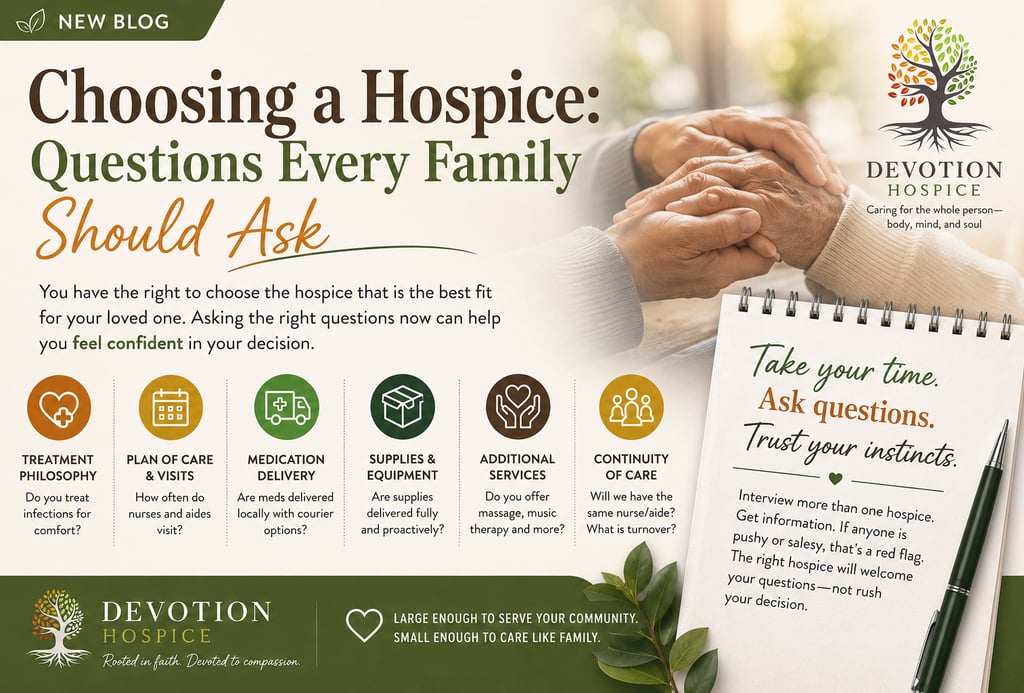
When someone you love is facing a life-limiting illness, choosing a hospice provider can feel overwhelming. Many families don't realize they have options, and they often choose the first hospice recommended to them without knowing what questions to ask.
HOSPICE BASICS
Bethany M Safadi, BSN, RN
6/26/20265 min read
Choosing a Hospice: Questions Every Family Should Ask Before Making a Decision
When someone you love is facing a life-limiting illness, choosing a hospice provider can feel overwhelming. Many families don't realize they have options, and they often choose the first hospice recommended to them without knowing what questions to ask.
I've been a hospice nurse for more than 20 years and now own a hospice agency. My goal in writing this isn't to convince you to choose one particular hospice. Every family deserves to make the decision that feels right for them. My hope is simply to help you ask thoughtful questions so you can find the hospice that best fits your loved one's needs.
Not all hospice agencies provide care in exactly the same way. Every Medicare-certified hospice must meet the Centers for Medicare & Medicaid Services (CMS) Conditions of Participation (CoPs), but there can be significant differences in how care is delivered, how quickly needs are addressed, what additional services are offered, and the overall experience families receive.
Remember: You Have a Choice
One of the biggest misconceptions is that your physician, hospital, or nursing facility chooses your hospice.
They don't.
You and your family have the legal right to choose the hospice provider you feel is the best fit.
Take advantage of that choice. Interview more than one hospice. Ask questions. Compare answers. The right hospice should welcome those conversations—not rush your decision.
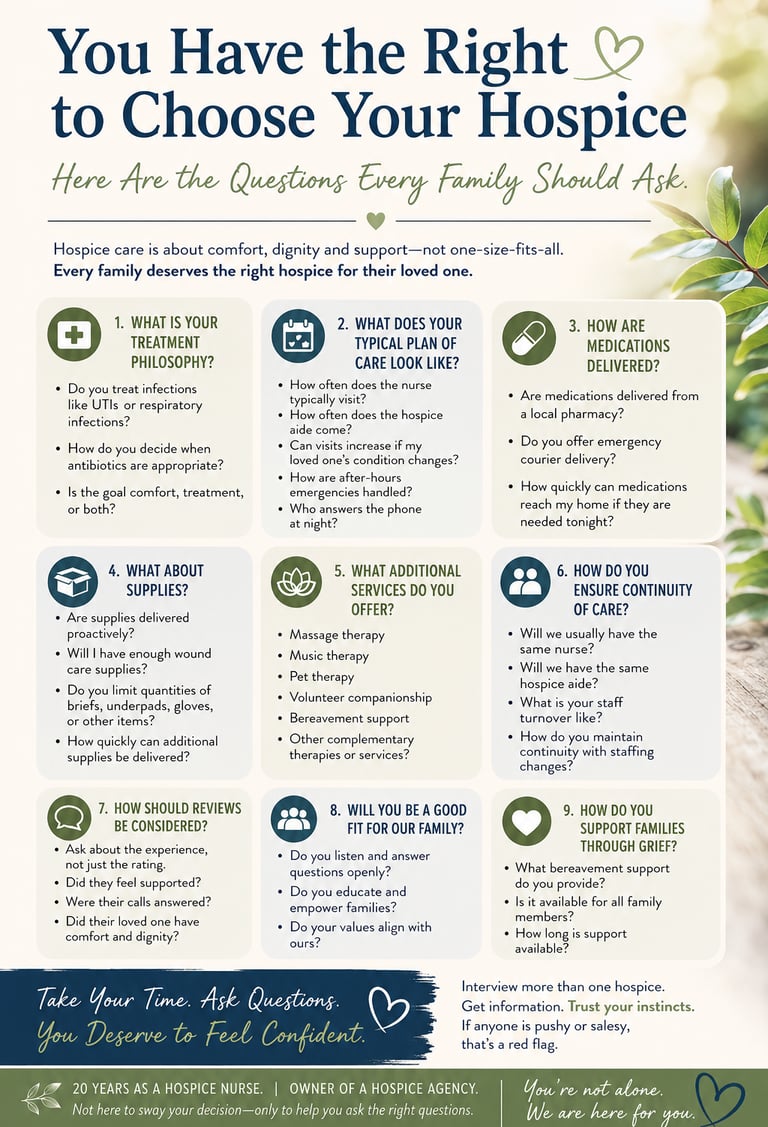
Ask About Their Treatment Philosophy
One of the biggest misconceptions is that hospice means "we stop treating everything."
That simply isn't true.
Hospice focuses on treatments that improve comfort and quality of life.
Ask the hospice:
Do you treat urinary tract infections when they are causing discomfort?
Will you treat respiratory infections if treatment will improve comfort?
How do you decide when antibiotics are appropriate?
Do you treat symptoms first, diagnosis first, or both?
There isn't always one right answer. Some infections are treated because they improve comfort and quality of life. Others may not be if the burden outweighs the benefit. What's important is understanding the hospice's philosophy before those decisions need to be made.
What Does Your Typical Plan of Care Look Like?
Every patient receives an individualized plan of care, but it's reasonable to ask what families can generally expect.
Questions to ask include:
How often does the nurse typically visit?
How often does the hospice aide come?
Can visits increase if my loved one's condition changes?
How are after-hours emergencies handled?
Who answers the phone overnight?
Will someone come to the home when needed?
Every patient's needs are different, but a hospice should be able to explain what a typical care plan looks like and how they adjust visits as needs change.
Ask How Medications Are Delivered
This is one question many families never think to ask.
Some hospices primarily use mail-order pharmacies.
Others utilize local pharmacies with courier delivery.
Why does this matter?
If your loved one suddenly develops uncontrolled pain, severe nausea, anxiety, or shortness of breath, waiting until the next day's mail delivery can feel like an eternity.
Ask:
Are medications delivered from a local pharmacy?
Do you offer emergency courier delivery?
How quickly can medications reach my home if they are needed tonight?
When symptoms change quickly, timely medication delivery can make a tremendous difference.
Ask About Supplies and Equipment
Hospice covers medical equipment and supplies related to the terminal illness, but the experience can vary.
Ask questions like:
Are supplies delivered proactively?
Will I have enough wound care supplies?
Do you limit quantities of briefs, underpads, gloves, or other commonly used items?
How quickly can additional supplies be delivered?
Families should never feel anxious about having the supplies needed to care for their loved one.
Ask About Additional Services
Hospice is much more than nursing visits.
Some agencies offer services beyond the Medicare minimum.
Ask whether they provide:
Massage therapy
Music therapy
Pet therapy
Aromatherapy
Art therapy
Volunteer companionship
Veteran recognition programs
Additional caregiver support
Bereavement resources beyond the standard requirements
These services may not be important to every family, but for many they become some of the most meaningful parts of the hospice journey.
Ask About Continuity of Care
One of the greatest comforts during hospice is building relationships with caregivers.
Ask:
Will we usually have the same nurse?
Will we usually have the same hospice aide?
What is your staff turnover?
If my regular nurse is unavailable, how do you ensure continuity of care?
Hospice is deeply personal. Having caregivers who truly know your loved one can make an enormous difference.
Profit vs. Nonprofit: Does It Really Matter?
One question I hear often is, "Should I choose a nonprofit hospice or a for-profit hospice?"
The honest answer is this:
Nonprofit versus for-profit is simply a tax status. It is not a measure of quality.
Every Medicare-certified hospice—regardless of tax status—must meet the exact same CMS Conditions of Participation, undergo surveys, follow federal and state regulations, and provide the same core hospice services.
Where hospices differ isn't whether they're nonprofit or for-profit.
They differ in how they choose to operate.
Some agencies invest heavily in staffing, education, specialty programs, and rapid response. Others may focus on keeping costs lower. Some offer massage therapy, music therapy, pet therapy, or other complementary services. Others provide only the required Medicare services. Some maintain smaller nurse caseloads and prioritize continuity of care, while others may have larger caseloads or more frequent staffing changes.
Those differences have nothing to do with tax status.
Instead of asking whether a hospice is nonprofit or for-profit, ask questions like:
How quickly do you respond to urgent needs?
What is your staff turnover?
Will I have the same nurse and hospice aide?
Do you deliver medications locally or by mail?
What additional services do you provide?
How often will my loved one be seen?
Those answers will tell you far more about the care you can expect than whether the organization is nonprofit or for-profit.
Be Careful When Reading Reviews
Online reviews can be helpful—but they rarely tell the entire story.
Hospice is unlike reviewing a restaurant or hotel. Families are experiencing one of the most emotional seasons of their lives.
Sometimes a loved one has a peaceful, well-supported death, and although grief is still profound, the family feels prepared and supported. Those experiences often lead to glowing reviews.
Other times, despite excellent hospice care, the death is emotionally difficult or the family wasn't emotionally ready to accept what was happening. Understandably, those experiences may result in negative reviews of the very same hospice.
Rather than relying solely on star ratings, ask people questions like:
Did you feel supported?
Were your phone calls answered promptly?
Did staff explain what to expect?
Was your loved one comfortable?
Did you trust the team?
Would you choose them again?
Those conversations often provide far more meaningful insight than a star rating.
Interview More Than One Hospice
Perhaps the most important advice I can give is this:
Interview multiple hospice agencies.
Ask each one the same questions.
Pay attention not only to the answers, but also to how those answers are given.
Do they listen?
Do they educate?
Do they encourage questions?
Do you feel respected?
If anyone pressures you to sign immediately or makes you feel like you're being "sold" something, I would encourage you to slow down. Hospice is one of the most important healthcare decisions a family will make, and you deserve the time and information needed to choose with confidence.
Final Thoughts
After more than 20 years as a hospice nurse and now as the owner of a hospice agency, I've learned one thing above all else:
The best hospice isn't necessarily the largest, the oldest, or the one with the most name recognition.
It's the hospice whose philosophy aligns with your family's values, communicates openly, responds when you need them, supports both the patient and the caregiver, and consistently shows up with compassion.
Ask questions.
Compare agencies.
Trust your instincts.
The right hospice team won't be offended by your questions.
They'll be grateful you asked.
Address
153 N. Milford Rd Suite 103
Highland, MI 48357
Contacts
Phone: 248-581-4000
Fax: 248-524-3922
24/7/365 Availability
248-581-4000